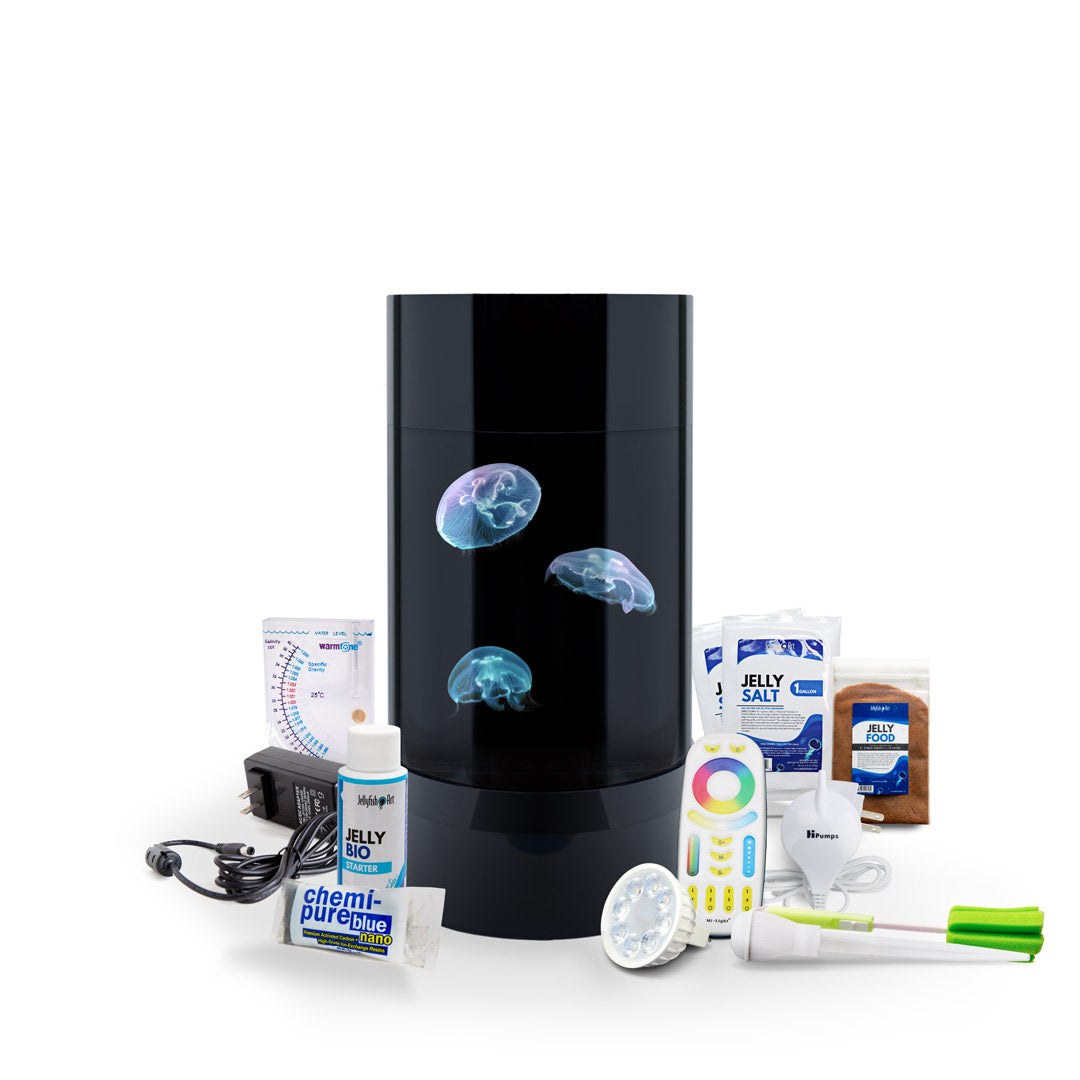
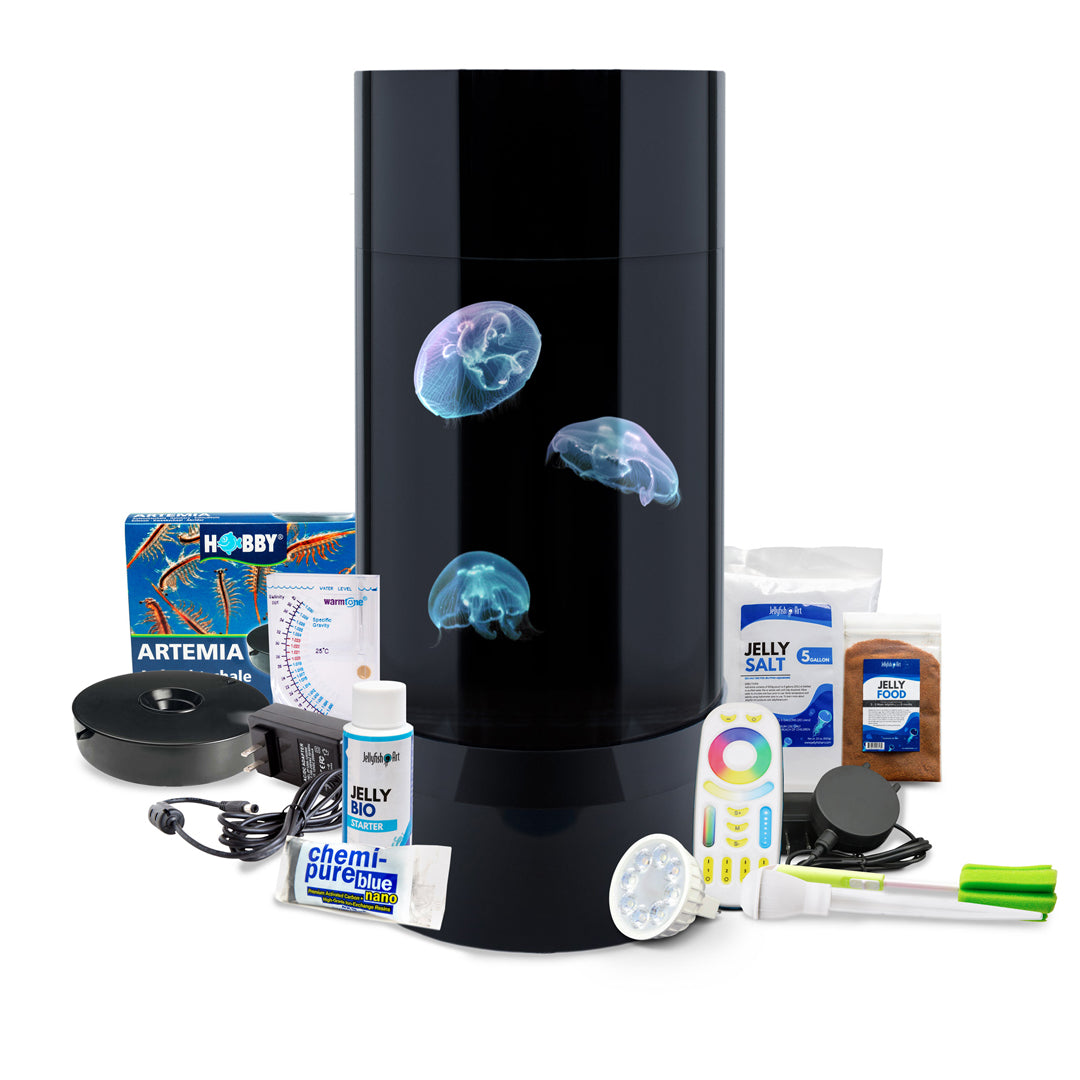
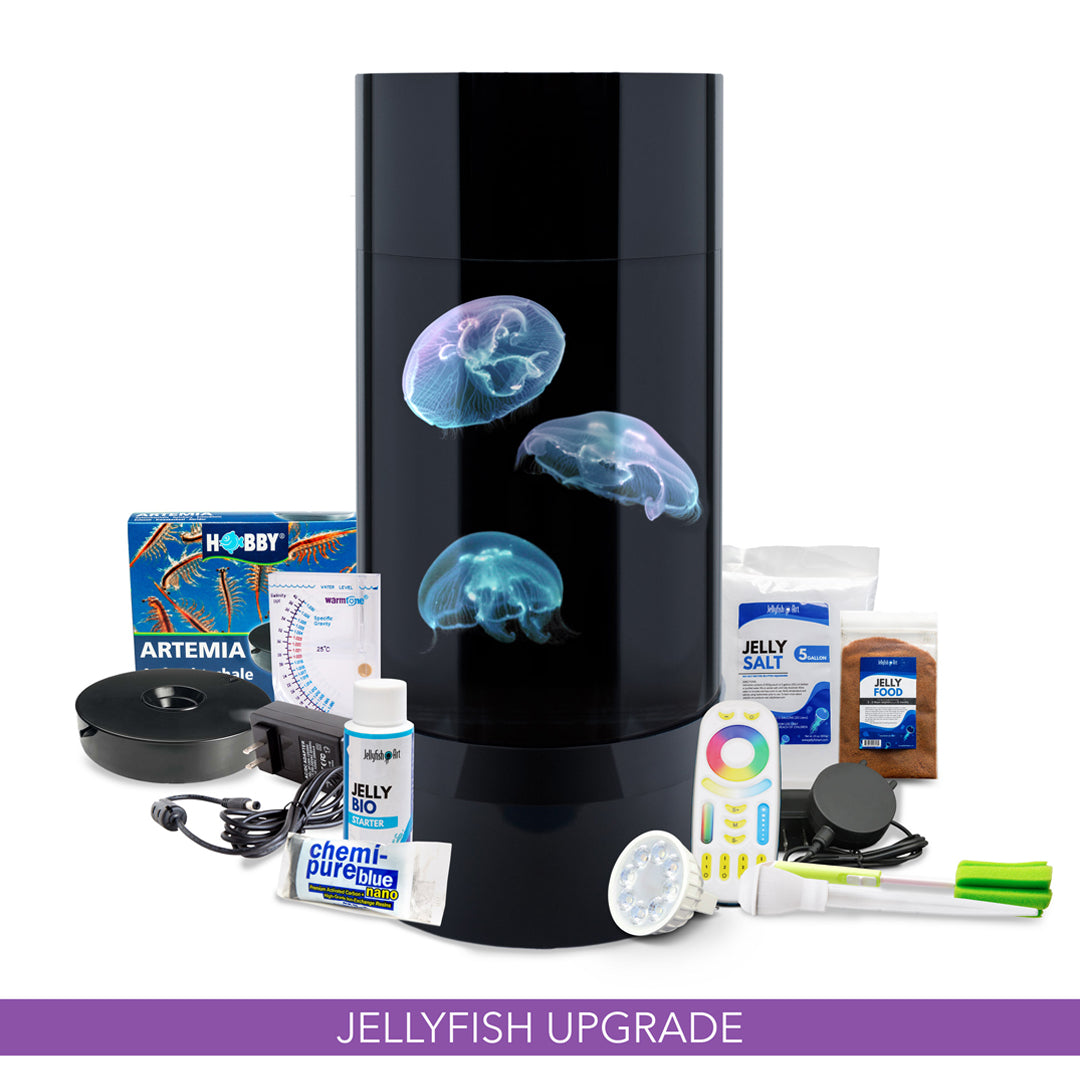
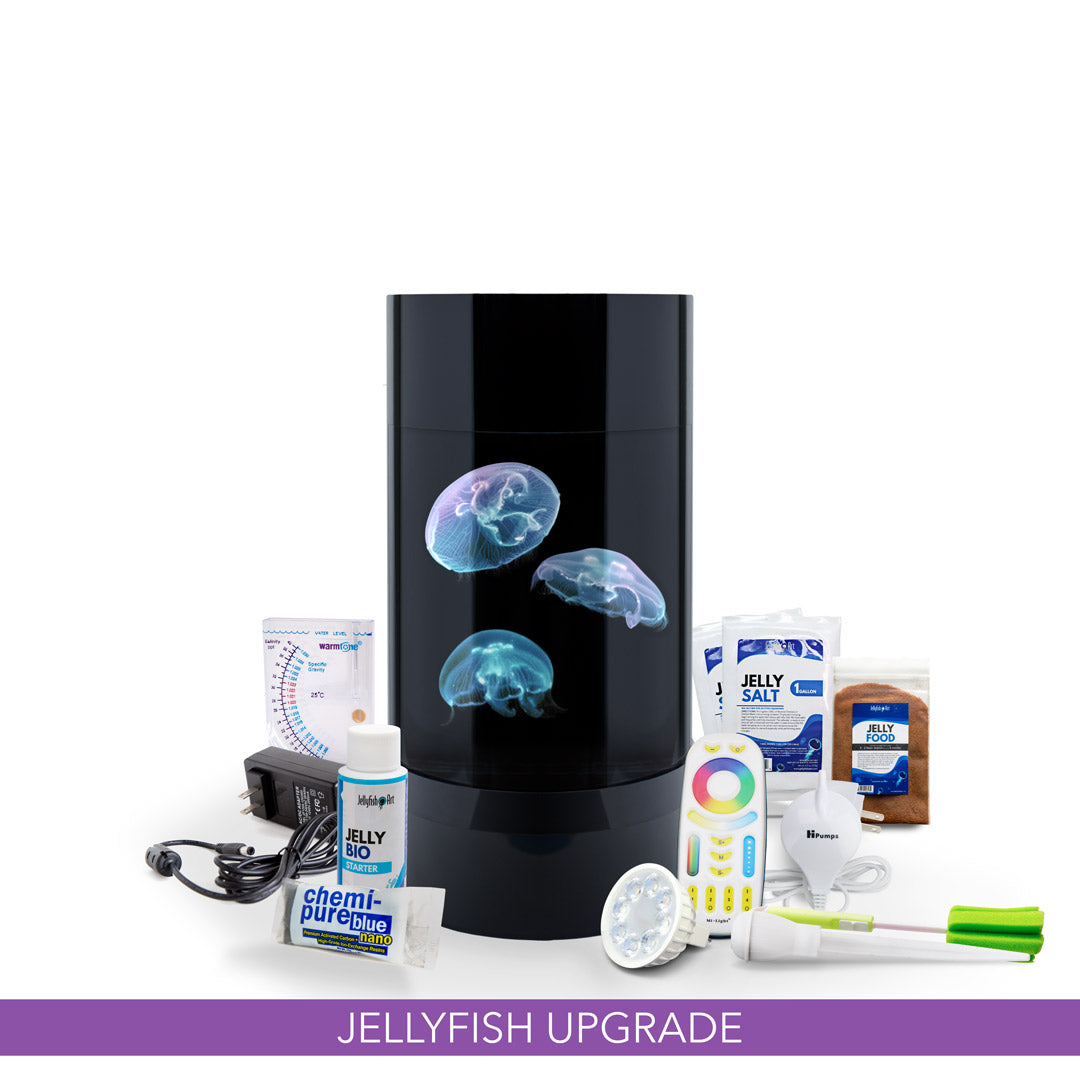
After your tank is all set up, you can order your jellyfish.
List of Parts
- Tank
- Airline
- Air Pump
- Hydrometer
- Power supply
- Substrate
- Color-changing LED
- LED remote control
Setting up Your Tank
Place tank away from direct sunlight, heat sources and electrical equipment. Please be mindful not to break off the small plastic bulkhead fitting on the bottom of the tank. If set on a flat surface and any weight is applied to the bulkhead fitting it can cause it to break off or crack.
Plug LED bulb into socket in tank base. Connect power supply to socket and run cord through square hole in bottom of base.
Plug short segment of airline tube (with check valve) into fitting at bottom of tank. Run airline through square hole in bottom of base. If your tank came with adjustable airline valve, attach it to end with air pump. If your tank did not come with adjustable airline valve, it will come with your jellyfish and you can attach it then.
Rinse substrate and drain in sink. Cover bottom of tank with substrate so it is at least 1 inch above water inlet. Do not cover LEDs. PRO TIP: More substrate covering inlet will prevent jellies from getting sucked into substrate.
If making own salt water, buy aquarium salt and use reverse osmosis-filtered or distilled water (indicated on label) found at aquarium and grocery stores. Follow mixing instructions on salt container. You can also buy pre-mixed salt water from aquarium stores. Do not use tap water unless it has passed through reverse osmosis filter. Britta filters do not work. Zero Water makes a home water filter that does, however.
Fill tank with salt water so water level is even with middle of opening on top of bubble channel. Doing this prevents suction issues.
Up Close:
Plug LEDs and air pump into electrical outlet and let tank run for at least 12 hours or until water turns from cloudy to clear.
Fill hydrometer with water and knock air bubbles from needle to verify salinity is between 30 and 34 ppt. If average room temperature falls below 60 Fahrenheit, add aquarium heater and set to 75 Fahrenheit. You can hide the heater under the substrate if it's too unsightly.
Now your tank is ready for jellyfish! Return here to order Moon Jellyfish and Frozen Food, which are shipped via FedEx overnight delivery according to our scheduler. Vouchers can be redeemed at this time.
Once your Desktop Jellyfish Tank is set up, you can order your live jellyfish from our website to be shipped right to your door. If you ordered a jelly kit, your account will already have credit for the jellyfish, food and shipping when you log in. Our flat rate for overnight shipping of live and frozen items is $34.
We offer an Arrive Alive Guarantee for two days on our jellyfish livestock. We guarantee jellyfish that leave our facilities will ARRIVE ALIVE at its destination and will STAY ALIVE for at least 48 hours with few exceptions.
If your purchase does not arrive alive or if it expires within 48 hours of receiving it, we will replace it for FREE (excluding shipping). The following conditions must apply:
You must take delivery of your order upon its arrival day and acclimate it to the tank that day.
Aquarist must acclimate the new arrivals according to our Acclimation Procedures even if they appear to be lifeless. Many times specimens that may look lifeless will frequently recover within minutes when properly acclimated. Improper care and not following the directions fully will void this warranty.
Tap water cannot have been used in the tank. Jellyfish require salt water that has been made from distilled water or passed through a reverse osmosis filter.
Delivery must be in the contiguous United States.
If your package is delivered at least one day late due to shipping delays, please contact the shipping company to file a late delivery claim claim. Jellyfish Art uses FedEx Express for all domestic shipments and they can be reached at fedex.com or 1 800 GO FEDEX . Please feel free to contact Jellyfish Art to help process these claims.
You must have purchased a Jellyfish Art tank in order to have your jellyfish shipment fall under the Arrive Alive guarantee. Jellyfish require special tanks designed specifically for jellyfish and Jellyfish Art cannot be held responsible for jellyfish placed in incorrectly designed tanks.
If You Suffer A Loss of Jellyfish:
File a claim with Jellyfish Art immediately. A form can be received by e-mailing info@jellyfishart.com.
Claims must be completed not more than 2 days after receiving jellyfish.
Jellyfish Art will replace the specimen or provide livestock credit for the amount of the purchase price.
Replacements are subject to availability.
Sorry, credit cards cannot be refunded for lost jellyfish. Shipping charges for replacement fish are the responsibility of the customer. Jellyfish Art does not pay shipping on replacement fish.
Hermit Crabs / Cleaner Snails:
In the event that a hermit crab or cleaner snail is dead on arrival or missing from your order Jellyfish Art will refund you the full cost of the item or provide store credit for the item(s), whichever you prefer. Shipping cost will NOT be covered or refunded.
Note this policy was updated on April 5th, 2012.
Jellyfish are shipped in sealed plastic bags inside insulated shipping boxes. They ship via FedEx Overnight Express to your door and remain perfectly healthy in their shipping containers for up to 36 hours so you have until the end of the arrival day to acclimate them to their tank. All jellyfish orders contain live rock, which jump starts the biological filtration process in your tank, making time-consuming cycling unnecessary. You can schedule the arrival date of your jellyfish to your convenience using our scheduler once your tank is up and running with water.
We cannot ship jellyfish to Hawaii, PO Boxes, Puerto Rico, other U.S. Territories, or other countries, except for orders to distributors. We do ship tanks and dry goods worldwide. Please see our international orders page for more details.
The entire aquarium industry is built on shipping live marine specimens all over the world, so our shipping methods are built on processes that have been perfected over decades. Since we specialize in jellyfish, we have customized our shipping methods to work specifically for jellyfish. Please be aware that we are selling live animals who grow and shrink according to their environmental conditions. Sizing is approximate to what we have in stock and we do not refund money based on size.
Once your Desktop Jellyfish Tank is set up, you're ready to order jellyfish. All orders containing live animals or frozen food ship with our $34 flat overnight rate, no matter how much is in the package. This shipping cost is included in all the jelly kits. Our Arrive Alive Guarantee ensures your jellies arrive in perfect health.
Ordering Jellyfish and Frozen Food
If your tank came with a voucher code for jellyfish or food, redeem here.
If you ordered your tank with jellyfish and food as a kit, order them here.
Acclimating Jellyfish and Live Accessories
Upon arrival, jellyfish must be gradually introduced to their new home because water conditions in shipping bag will be different from those inside tank. If you ordered additional live accessories, follow same instructions for jellyfish unless otherwise noted.
Acclimation Overview: Checklist Be sure to read detailed instructions for each checklist item below.
Before Acclimation:
- Someone is available to receive & acclimate jellyfish
- Desktop Tank is set up and running
During Acclimation:
- Add live rock
- Water exchange between tank and bags
- Introduce jellyfish to tank
- Feeding
- 25% water change
Acclimation
Jellyfish arrive in an insulated shipping container. Make sure someone will be available to receive jellyfish shipment on your scheduled delivery day. We recommend getting them delivered at work so the package can be taken out of the elements until the jellies can be introduced to the tank. You have until the end of the delivery day to acclimate them to tank, but it is best to do it as soon as possible. You will receive an email with your FedEx tracking number the evening before your jellyfish arrive.
Insulated shipping container includes small bag of live rock* with colony of helpful bacteria that filters jellyfish waste. Before adding jellyfish, empty contents of live rock bag into tank with substrate to seed bacteria colony. Do not cover LED lights.
Gently empty contents of inner bags into large outer bag so all jellyfish are swimming together.
Roll back edges of bag and place it in tank so it floats at surface. Scoop some water from the tank into the bag. The volume of water in each scoop should be about 10% of the total volume of the bag. Be gentle to ensure air bubbles don't get trapped underneath jellyfish. Repeat one scoop every 5 minutes for 1 hour until shipping bag water is thoroughly mixed with tank water. PRO TIP: Acclimating for 2 hours or more is better for jellyfish.
Submerge jellyfish bag in tank and allow jellyfish to swim out. Make sure jellyfish are not exposed to air. Add water to tank or scoop out as needed to keep water level even with middle of bubble channel opening.
Up Close:
Jellies may not swim much for first several hours while acclimating to new home. Once jellyfish are comfortable, they will move almost constantly. If your tank did not come with an adjustable airline valve, attach the airline valve that was included with your jellyfish in between the air pump and the existing airline. Adjust airline valve so there is a steady stream of bubbles to provide water flow. If jellies get struck to substrate or top of bubble channel, turn airline valve to decrease flow. You may need to observe effects of flow and adjust over several days.
Wait at least 12 hours before feeding jellyfish for first time.
Do first water change on second day. Do another on fifth day. Thereafter do 25% water changes once a week. PRO TIP: More frequent water changes optimize health of jellyfish.
* What is live rock? All aquariums require a live colony of nitrifying bacteria to digest fish waste. Traditionally, it’s necessary to “cycle” the aquarium for 2-4 weeks to allow this colony to grow. Instead, Jellyfish Art uses a process called “seeding” to bypass the time-consuming cycle. Live rock saturated in nitrifying bacteria is shipped from Jellyfish Art’s breeding facility with all live orders. Add this live rock to your jellyfish tank to instantly seed a beneficial bacteria colony.
Jellyfish cannot survive in a regular aquarium because they would get sucked into the pump intakes, like bunches of wet tissue paper.
Jellyfish Art's jellyfish tank is specially designed with a water flow pattern that keeps jellyfish from getting sucked into pump intakes. Also, water flow is powered by the rise of air bubbles from an air pump, not a water pump, so flow is more gentle.
Water flows through the substrate at the bottom of the tank, which spreads it out over a large surface area so there are no strong points of suction to harm the jellyfish. The water flows through the gaps between the substrate particles down towards the bottom of the bubble channel. Here the rise of air bubbles from the air pump drives water flow up the bubble channel. Water exits the top of the bubble channel at an angle and drives a circular motion of water flow, which keeps the jellyfish away from the edges of the tank. This tank design is called a "kreisel" and was developed in the 1960s by a German oceanographer to house plankton onboard research vessels. Fish and other animals are also perfectly happy in a jellyfish aquarium.
You can make your own salt water for your jellyfish aquarium by mixing water and aquarium salt. Do not use regular table salt. You can also buy salt water from your local aquarium shop, usually for about $1/gallon. Bring your own jugs or buy them at the store.
Do not make salt water from tap water that has not passed through a RO (Reverse Osmosis) filter. Even if you have high quality tap water that is safe to drink, it can contain contaminants that are harmful to jellyfish. You can buy RO-filtered water or distilled water from your local grocery or aquarium store. Look at the label on the water container to confirm it is what you need.
When mixing your own salt water, follow dosing instructions on the salt container. Remember, the Desktop Jellyfish Tank holds about 6 gallons. Allow the salt to completely mix and dissolve for 24 hours. Mix the salt and water in a separate container if there are already jellyfish in your tank. Use your hydrometer to measure salinity. Add more salt or fresh water as needed to bring the salinity between 30 and 34ppt. Once salinity is correct, run your pump at least 24 hours before adding jellyfish. This will allow the pH to stabilize and the water to oxygenate.